When you buy through our links, we earn a small commission — and that is what funds all the free education here. It never costs you more. Products are not intended to diagnose, treat, cure, or prevent any disease.
What it is
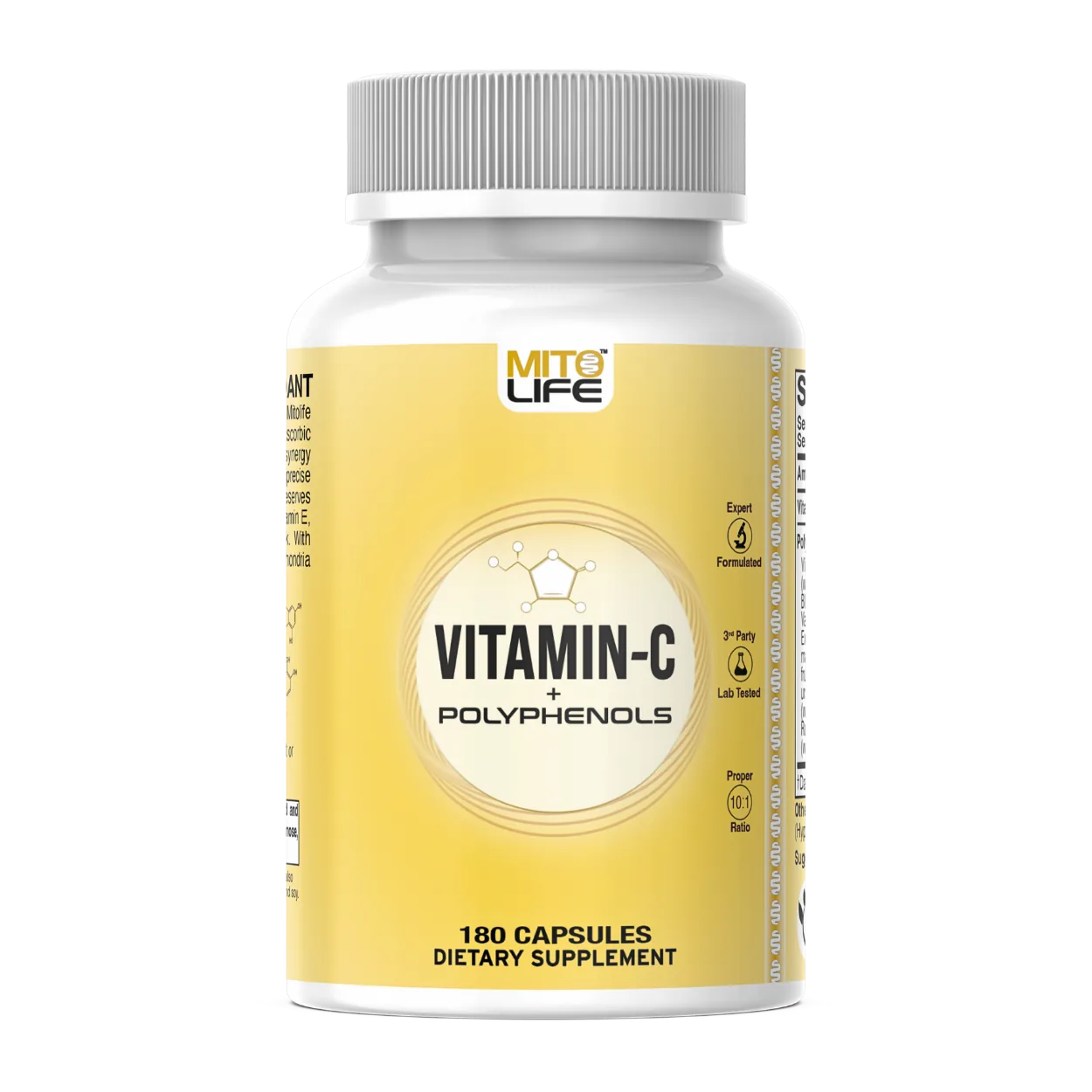
Vitamin C (ascorbic acid) delivered alongside plant polyphenols, closer to the way whole foods package it than an isolated ascorbic-acid tablet. Vitamin C is a water-soluble antioxidant and an essential cofactor the body cannot make, and the added polyphenols contribute their own antioxidant activity.
Why the evidence supports it
Vitamin C is one of the most thoroughly established nutrients there is, and its reach is unusually wide. The evidence firmly ties it to antioxidant defense, normal immune-cell function, and collagen synthesis — and it is the classic cofactor for iron: it converts plant (non-heme) iron into the form the gut can actually absorb and helps move it into transport, which is why poor vitamin C status sits behind poor iron status, and why the two are paired for healthy iron levels. Beyond iron it is a cofactor across a long list of the body's enzyme reactions, from building connective tissue to making neurotransmitters. As a front-line electron donor it also buffers oxidative stress — including the oxidative load that environmental stressors like EMF are studied to generate, an emerging but reasonable use for a water-soluble antioxidant the body cannot make itself. Pairing it with polyphenols mirrors how food delivers it. That is the cell's Maintain function in plain terms — oxidative balance, immune work, iron handling, and connective-tissue upkeep — kept to everyday-adequacy doses, not the mega-dose or IV-style claims, which are a different conversation.
What it supports
- Supports the body's normal antioxidant defenses
- Supports normal everyday immune function
- Helps the body absorb iron from plant foods
- Provides vitamin C alongside food-like polyphenols
Which function it supports
Ties to the cell's Maintain function — vitamin C and polyphenols help buffer oxidative stress and support the immune cells' everyday work.
Learn the why behind this pillarHow it relates to your cells and mind
Every product here ties back to a specific job your body does. This one touches the functions below — follow either link to see the mechanism in full, then dig into the studies.
What it is made of — and the mechanisms behind it
Each ingredient acts on several of the body's functions. Taken together, this product touches these cell and mind functions — follow any to see the mechanism in full.
The ingredients
Mechanisms drawn from our ingredient knowledge base (2 profiled ingredients). Structure and function only — not a treatment claim.
The science on the ingredients
The antioxidants and pro-antioxidants network: an overview.2004
A review describes the body's antioxidant defense system, including nutrients like vitamins C and E and mineral-dependent enzymes, as a coordinated network in which a deficiency in one component can reduce the effectiveness of the others.
Vertuani S; Angusti A; Manfredini S — Current pharmaceutical design
Vitamin C reduces the severity of common colds: a meta-analysisMeta-analysis2023
A meta-analysis of 10 placebo-controlled trials found vitamin C reduced the duration of more severe cold symptoms, though it showed less effect on mild symptoms.
Hemila H — PubMed Central (PMC)
Biochemical Composition of Different Table Grape Cultivars Produced in SloveniaSystematic review2019
Cited in Lustig's "Metabolical" (Chapter 19: Food subtractions) to support the claim: "lower the Vitamin C."
M. Mikulic-Petkovsek et al — J. Horticult. Sci. Biotech. 94 (
Vitamin C for preventing and treating the common coldSystematic review2013
This Cochrane review found regularly-taken vitamin C modestly shortened cold duration, by about 8% in adults, but did not prevent colds in the general population.
Hemila H, Chalker E — Cochrane Database of Systematic Reviews
Effect of oral vitamin C supplementation on serum uric acid: A meta-analysis of randomized controlled trialsMeta-analysis2011
Meta-analysis of RCTs: vitamin C supplementation significantly reduced serum uric acid (-0.35 mg/dL pooled).
Juraschek SP et al. — Arthritis Care & Research
The Effects of Dietary Supplementation with Collagen and Vitamin C and Their Combination with Hyaluronic Acid on Skin Density, Texture and Other Parameters: A Randomised, Double-Blind, Placebo-Controlled TrialEstablishedRandomized controlled trial2024
In a 16-week double-blind, placebo-controlled trial, 5 g hydrolyzed collagen with 80 mg vitamin C daily significantly improved dermis density and skin texture and reduced wrinkle severity, while showing no significant effect on elasticity or hydration.
Katja Žmitek; Janko Žmitek; Hristo Hristov; Mirjam Rogl Butina; Petra Keršmanc; Tina Pogačnik — Nutrients
Investigating the effects of vitamins E and C on oxidative stress and hematological parameters among power plant workers: A double-blind randomized controlled clinical trialEmergingRandomized controlled trial2020
In 91 power plant workers exposed to extremely low-frequency electromagnetic fields, 1000 mg of vitamin C daily for 90 days raised antioxidant enzyme levels and lowered malondialdehyde, a marker of lipid peroxidation.
Hosseinabadi MB; Khanjani N; Norouzi P; Mirzaii M; Biganeh J; Nazarkhani F — Toxicology and Industrial Health
Vitamin C-enriched gelatin supplementation before intermittent activity augments collagen synthesisRandomized controlled trial2017
A randomized crossover trial found that consuming vitamin C-enriched gelatin one hour before intermittent exercise roughly doubled a blood marker of collagen synthesis compared with placebo.
Shaw G, Lee-Barthel A, Ross ML, Wang B, Baar K — American Journal of Clinical Nutrition
A Randomised Cross-Over Pharmacokinetic Bioavailability Study of Synthetic versus Kiwifruit-Derived Vitamin CRandomized controlled trial2013
This crossover trial compared blood vitamin C levels after synthetic ascorbic acid versus a whole-food kiwifruit source in the same volunteers.
Study authors — PubMed Central (PMC)
Synthetic or Food-Derived Vitamin C -- Are They Equally Bioavailable?Clinical trial2013
Synthetic ascorbic acid and food-derived vitamin C show no consistent difference in bioavailability in most steady-state studies.
Nutrients, 2013 — PMC3847730
The effect of quercetin supplementation on selected markers of inflammation and oxidative stressRandomized controlled trial2013
A randomized, double-blind trial found that 8 weeks of quercetin supplementation, alone or combined with vitamin C, reduced inflammatory and oxidative stress biomarkers in physically active adults.
Askari G, Ghiasvand R, Feizi A, Ghanadian SM, Karimian J. — Journal of Research in Medical Sciences
Increased vitamin plasma levels in Swedish military personnel treated with nutrients prior to automatic weapon trainingClinical trial2011
A human feasibility study found that a beta-carotene, vitamin C, vitamin E, and magnesium combination reliably raised plasma nutrient levels in military personnel before weapons-noise exposure.
Le Prell CG, Johnson AC, Lindblad AC, Skjonsberg A, Ulfendahl M, Guire K, Green GE, Campbell KCM, Miller JM — Noise Health
Antioxidants prevent health-promoting effects of physical exercise in humansRandomized controlled trial2009
In this human trial, taking high-dose vitamin C and E blunted the improvement in insulin sensitivity normally produced by exercise, suggesting the exercise-induced oxidative signal itself is part of the benefit.
Ristow M et al. — Proceedings of the National Academy of Sciences 106(21):8665-8670
Human adrenal glands secrete vitamin C in response to adrenocorticotrophic hormoneClinical trial2007
In a human study, ACTH stimulation triggered a rapid rise in adrenal-vein vitamin C that preceded the cortisol rise, showing vitamin C release is part of the acute stress response.
Padayatty SJ, Doppman JL, Chang R, Wang Y, Gill J, Papanicolaou DA, Levine M — American Journal of Clinical Nutrition
The effects of vitamin C supplementation on serum concentrations of uric acid: results of a randomized controlled trialRandomized controlled trial2005
500mg/day vitamin C for 2 months significantly lowered serum uric acid vs placebo. PMID 15934094.
Huang HY, Choi HK et al. — Arthritis & Rheumatism
Effect of ascorbic acid intake on nonheme-iron absorption from a complete dietClinical trial2001
In this controlled feeding study, vitamin C meaningfully enhanced non-heme iron absorption from single meals, though the effect was smaller across a full day's mixed diet.
Cook JD, Reddy MB — American Journal of Clinical Nutrition 73(1):93-98
Vitamins C and E: beneficial effects from a mechanistic perspectiveEstablishedExpert review2011
Vitamin C also serves as a cofactor for enzymes that build collagen, while vitamin E scavenges fat-soluble free radicals; together they support two distinct but complementary parts of the antioxidant network.
Traber MG, Stevens JF — Free Radical Biology and Medicine
Vitamin C reduces the severity of common colds: a meta-analysisExpert review2023
A meta-analysis of 10 trials found vitamin C supplementation associated with a 15% reduction in common-cold symptom severity compared to placebo.
Hemilä H, Chalker E — BMC Public Health
Crystal structure of the collagen prolyl 4-hydroxylase (C-P4H) catalytic domain complexed with PDIExpert review2022
This structural study maps the enzyme complex that vitamin C activates to hydroxylate proline residues during collagen assembly.
Study authors — PubMed Central (PMC)
Vitamin C as a Supplementary Therapy in Relieving Symptoms of the Common Cold: A Meta-Analysis of 10 Randomized Controlled TrialsExpert review2020
This meta-analysis found vitamin C supplementation associated with better total efficacy and faster symptom resolution when combined with standard cold-symptom care.
et al. — BioMed Research International
Vitamin C and Neutrophil Function: Findings from Randomized Controlled TrialsExpert review2019
Randomized trial data show vitamin C helps neutrophils move toward pathogens, engulf them, and generate reactive oxygen species used for microbial killing.
Carr AC, Rosengrave PC, Bayer S, et al. — Nutrients
Vitamin C and Immune FunctionExpert review2017
This widely cited review explains how vitamin C supports both innate and adaptive immune cell function and helps maintain the skin's barrier against pathogens.
Carr AC, Maggini S — Nutrients
Vitamins and Minerals for Energy, Fatigue and Cognition: A Narrative Review of the Biochemical and Clinical EvidenceEmerging2020
B vitamins, vitamin C, iron, magnesium, and zinc each have biochemical roles in cellular energy metabolism that plausibly link low status to fatigue and reduced cognition.
Tardy AL, Pouteau E, Marquez D, Yilmaz C, Scholey A — Nutrients
Vitamin C intake and osteoarthritis: findings of NHANES 2003-2018 and Mendelian randomization studyContested2024
Large human cross-sectional analysis (NHANES, n=31,527) plus Mendelian randomization found no association between vitamin C intake and osteoarthritis risk; an honest counterweight showing vitamin C's cartilage role is biochemical rather than a demonstrated joint outcome.
Zhang H; Jiang X; Bai L; Chen J; Luo W; Ma J; Ma X — Frontiers in nutrition
Balanced by design — we show supporting and contradicting findings. Search all studies
No product works in isolation
Every cell function above — Sense, Exchange, Transform, Build, Maintain, Adapt — needs the same broad base of optimal micronutrient levels running underneath it, all the time. Vitamin C with Polyphenols is not a stand-alone fix; it is one piece that plugs into that larger system. The foundation comes first, and this supports it.
Stacks well with
Pick your goal — here is what Vitamin C with Polyphenols pairs with for each. Nothing works in isolation; these share the same systems.
For Immune
For Epigenetics
For Foundation Nutrition
For Minerals
Foundational, or targeted?
Not everything in the shop is meant to be taken forever. Some products here are foundational — a daily nutrient base built for long-term, ongoing use. Others are targeted -- shorter-term support for a specific season, not a lifelong habit. If you are not sure which one this is, that is a fair question to ask us before you buy.
Learn more, on your terms
Do not take our word for it — go read. Each topic below opens a pre-loaded search so you can explore the nutrient, the mechanism, or the device for yourself.
Search the full studies libraryHow to use it
Take with water, with or without food, once daily. Splitting the dose across the day can be gentler on the stomach if you take a larger amount. Follow the label.
Use code HOLISTICLOVE at checkout.
Where to get it
We are lining up the best way to get this one to you. In the meantime, reach out and we will point you the right way — or browse the full shop to see every product.
See the full shopThe studies
See the research behind the science we point to.
Explore studiesThe blog
Plain-language reads on how it all fits together.
Read the blogOptimal nutrients are the definition of longevity
Long-term cell function depends on having what it needs, at the level it needs it, for as long as it needs it. That is the whole thesis behind everything we point you to here.
When you buy through our links, we earn a small commission — and that is what funds all the free education here. It never costs you more. Products are not intended to diagnose, treat, cure, or prevent any disease.
Vitamin C with Polyphenols pairs vitamin C with plant polyphenols, the way whole foods tend to package it, rather than ascorbic acid on its own. It supports antioxidant defense and the normal, everyday work of the immune system. It fits people who want vitamin C closer to how food delivers it.
Common questions
What does Vitamin C with Polyphenols support?+
It supports the body's normal antioxidant defenses and normal everyday immune function, helps the body absorb iron from plant foods, and provides vitamin C alongside food-like polyphenols.
How do I take it?+
Take with water, with or without food, once daily. Splitting the dose across the day can be gentler on the stomach if you take a larger amount. Follow the label.
What makes it different?+
Delivering vitamin C alongside polyphenols is closer to how you would get it from real food. It stays grounded at everyday doses rather than reaching for mega-dose or IV-style claims.