When you buy through our links, we earn a small commission — and that is what funds all the free education here. It never costs you more. Products are not intended to diagnose, treat, cure, or prevent any disease.
What it is
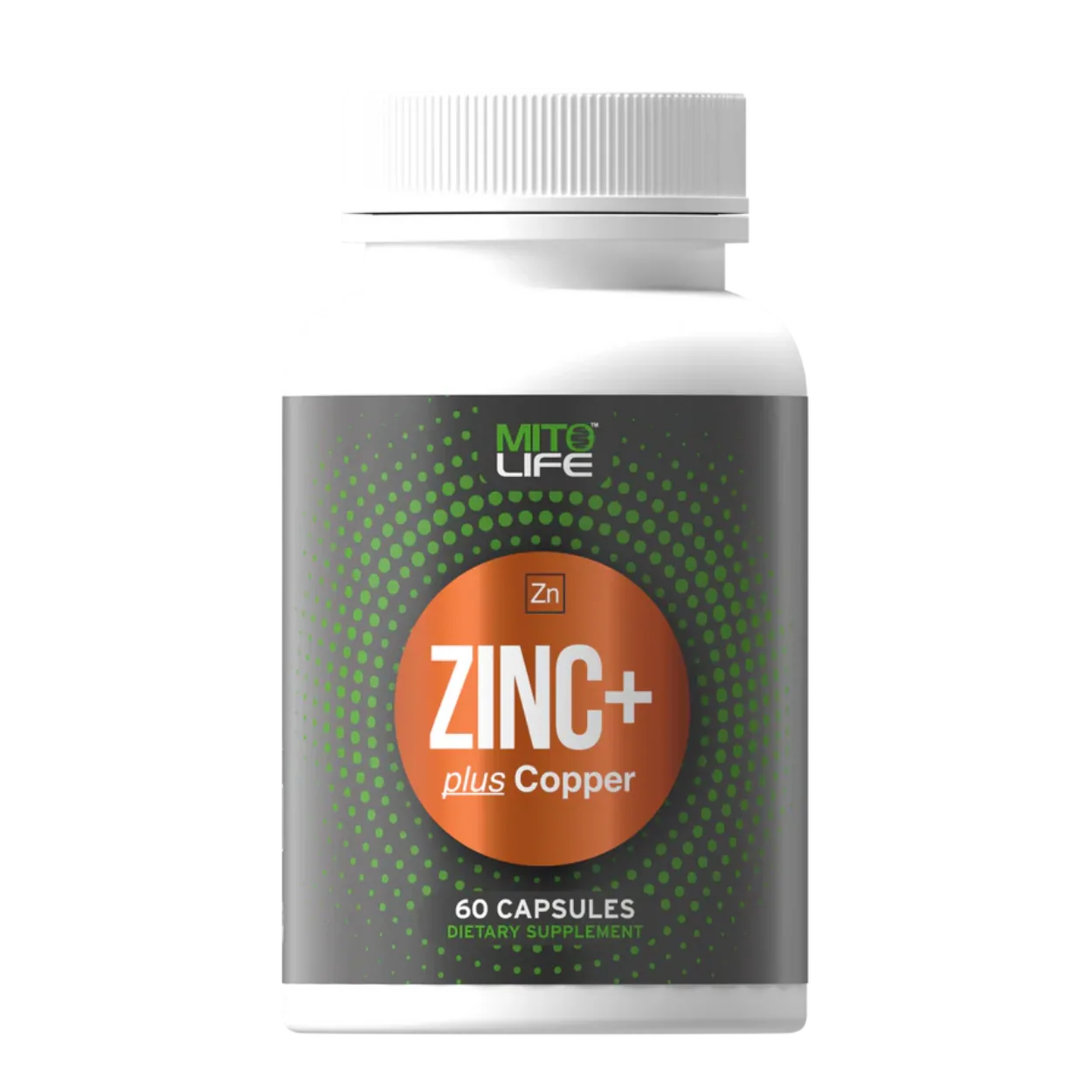
A supplement that pairs zinc with copper in a deliberate, sensible ratio. The pairing is straight physiology: zinc and copper compete for the same absorption pathway, so taking zinc on its own for a stretch can gradually draw down the body's copper. Supplying both keeps that balance intact.
Why the evidence supports it
The zinc-copper interaction is well-documented mineral physiology, not a fringe idea — the two share an absorption pathway, and sustained zinc-alone intake is a recognized way to quietly create a copper shortfall. Pairing them is the evidence-based way to support zinc status without opening that gap. Both minerals sit behind large numbers of enzymes, so keeping their ratio steady serves the cell's Maintain function — the everyday upkeep those enzymes carry out. Zinc's reach is bigger than most realize: it is most concentrated in bone, the eyes, and reproductive tissue, and because bone is the living home of the marrow where immune cells are made, zinc and copper sit at the crossroads of bone strength and immune function at once. Zinc is even central to the 'spark of life' — the burst of zinc a human egg releases at the moment of fertilization. For the same minerals in whole-food form, this pairs with Desiccated Oyster. If you take other zinc-containing products, count this toward your total.
What it supports
- Supports normal zinc status and immune function
- Keeps zinc and copper in a healthy balance
- Helps avoid the copper drawdown that zinc-alone can cause
- Supports normal everyday mineral balance
Which function it supports
Ties to the cell's Maintain function — zinc and copper both sit behind many enzymes, and keeping their ratio steady supports normal cellular upkeep.
Learn the why behind this pillarHow it relates to your cells and mind
Every product here ties back to a specific job your body does. This one touches the functions below — follow either link to see the mechanism in full, then dig into the studies.
What it is made of — and the mechanisms behind it
Each ingredient acts on several of the body's functions. Taken together, this product touches these cell and mind functions — follow any to see the mechanism in full.
The ingredients
Mechanisms drawn from our ingredient knowledge base (3 profiled ingredients). Structure and function only — not a treatment claim.
The science on the ingredients
Reported zinc, but not copper, intakes influence whole-body bone density, mineral content and T score responses to zinc and copper supplementation in healthy postmenopausal womenEstablishedRandomized controlled trial2011
Over two years in 224 postmenopausal women, added zinc and copper did not protect bone overall and the largest declines occurred in that group, though benefit appeared only in women whose usual zinc intake was under 8 mg daily.
Nielsen FH; Lukaski HC; Johnson LK; Roughead ZK — The British Journal of Nutrition
Recent advances in the understanding of the role of zinc in ocular tissuesEstablishedExpert review2014
Zinc is the most abundant trace metal in the retina, with loosely bound zinc concentrated in the retinal pigment epithelium and photoreceptors where it supports phototransduction, rhodopsin regeneration and synaptic signalling.
Ugarte M; Osborne NN — Metallomics
Zinc exocytosis is sensitive to myosin light chain kinase inhibition in mouse and human eggsEstablished2020
In both mouse and human eggs, blocking myosin light chain kinase cut zinc spark intensity by about 80 percent, showing zinc release at egg activation depends on cortical granule trafficking machinery.
Lee HC; Edmonds ME; Duncan FE; O'Halloran TV; Woodruff TK — Molecular Human Reproduction
A Potential New Role for Zinc in Age-Related Macular Degeneration through Regulation of Endothelial FenestrationEmerging2021
In an endothelial cell model, zinc sulfate redistributed the diaphragm protein PV-1 and produced normally sized fenestrae, suggesting zinc helps maintain the porous choriocapillaris that supplies the retina.
Cunningham F; Cahyadi S; Lengyel I — International Journal of Molecular Sciences
A zinc-dependent mechanism regulates meiotic progression in mammalian oocytesEstablishedAnimal study2012
Rising intracellular zinc held the egg in metaphase II arrest and the drop in zinc after fertilization released it, acting through the zinc-binding cytostatic factor protein EMI2.
Bernhardt ML; Kong BY; Kim AM; O'Halloran TV; Woodruff TK — Biology of Reproduction
Zinc sparks are triggered by fertilization and facilitate cell cycle resumption in mammalian eggsEstablishedAnimal study2011
Fertilization triggered mammalian eggs to eject billions of zinc atoms in coordinated bursts the authors named zinc sparks, and this zinc loss was required for the egg to resume its cell cycle.
Kim AM; Bernhardt ML; Kong BY; Ahn RW; Vogt S; Woodruff TK; O'Halloran TV — ACS Chemical Biology
The inflammation saga: Breakthrough nutritional insights for poultry.2026
A poultry nutrition symposium reviewed how dietary fiber, amino acids like threonine, glutamine, and arginine, and other feed components influence gut integrity, microbial balance, and immune activation related to gut inflammation.
Jha R; Korver D; Kim WK; Marchal L; Gibbs K; Halley J — Poultry science
Magnesium, Zinc and Copper in Lung Fibrosis: A Narrative Review.2025
A review describes how lower zinc and magnesium levels and a higher copper-to-zinc ratio are frequently seen in idiopathic pulmonary fibrosis patients, biometal imbalances linked to oxidative stress and fibroblast proliferation in the disease's pathogenesis.
Nechifor M; Zamfir CL; Gales C — Medicina (Kaunas, Lithuania)
Resisting death by metal: metabolism and Cu/Zn homeostasis in bacteria.2024
A review summarizes how bacteria regulate cellular copper and zinc levels to avoid both metal starvation and toxicity, describing resistance mechanisms independent of metal efflux systems relevant to host-microbe interactions.
Sullivan MJ; Terán I; Goh KGK; Ulett GC — Emerging topics in life sciences
Host Immune-Metabolic Adaptations Upon Mycobacterial Infections and Associated Co-Morbidities.2021
Review describes how macrophages respond metabolically to mycobacterial infections causing tuberculosis and leprosy, and how co-morbidities like smoking, diabetes, and HIV shape these host metabolic responses and disease outcomes.
Llibre A; Dedicoat M; Burel JG; Demangel C; O'Shea MK; Mauro C — Frontiers in immunology
The Bioinorganic Chemistry of Mammalian Metallothioneins.2021
A review challenges older assumptions about metallothionein structure, describing these zinc- and copper-binding proteins as dynamic, redox-active metal buffers that exist in multiple forms and regulate cellular zinc and copper availability through pH-sensitive coordination chemistry.
Krężel A; Maret W — Chemical reviews
The Role of Zinc and Copper in Gynecological Malignancies.2020
Zinc and copper homeostasis regulates enzymatic antioxidant systems, and imbalances between low zinc and high copper are linked to oxidative stress relevant to gynecological malignancy research.
Michalczyk K; Cymbaluk-Płoska A — Nutrients
Zinc stress induces copper depletion in Acinetobacter baumannii.2017
In the bacterium Acinetobacter baumannii, extracellular zinc stress triggered copper depletion that was not rescued by copper supplementation, with the genome containing 13 candidate zinc and copper resistance efflux pumps.
Hassan KA; Pederick VG; Elbourne LD; Paulsen IT; Paton JC; McDevitt CA; Eijkelkamp BA — BMC microbiology
Metallothionein, Copper and Alpha-Synuclein in Alpha-Synucleinopathies.2017
Copper accumulates in the aging brain and binds alpha-synuclein to initiate its aggregation, the key pathological driver of Parkinson's disease, while metallothioneins regulate copper's bioavailability and redox activity.
Okita Y; Rcom-H'cheo-Gauthier AN; Goulding M; Chung RS; Faller P; Pountney DL — Frontiers in neuroscience
Detection and Manipulation of the Stress Response Protein Metallothionein.2017
A review describes metallothionein as a stress-response protein that stores zinc and copper, buffers free radicals, and neutralizes toxic metals like mercury and cadmium, with emerging roles in inflammatory conditions and cancer cell metastasis.
Bhandari S; Melchiorre C; Dostie K; Laukens D; Devisscher L; Louwrier A; Thees A; Lynes MA — Current protocols in toxicology
Dynamic action of neurometals at the synapse.2011
A review describes how synaptic zinc, co-released with glutamate, and copper both interact with calcium channels and calcium signaling, potentially contributing to synaptic neurotransmission and plasticity such as long-term potentiation.
Tamano H; Takeda A — Metallomics : integrated biometal science
Carnosine and its possible roles in nutrition and health.2009
Carnosine, a dipeptide with antiaging activity, scavenges reactive oxygen and nitrogen species, chelates zinc and copper ions, and resists glycation and cross-linking damage from reactive aldehydes like malondialdehyde.
Hipkiss AR — Advances in food and nutrition research
Essentiality, toxicology and chelation therapy of zinc and copper.2005
Review of zinc and copper explains that while essential for cellular function, both metals can become toxic in excess, especially in certain genetic disorders, and surveys chelation therapy and metallothionein upregulation as potential treatments.
Cai L; Li XK; Song Y; Cherian MG — Current medicinal chemistry
Zinc supplementation on glycemic biomarkersEmergingMeta-analysis2024
Pooled reductions in fasting glucose insulin HOMA-IR and HbA1c -- Umbrella evidence contains overlapping meta-analyses
Daneshvar M et al. — Diabetology & Metabolic Syndrome
Correlation between serum zinc and testosterone: A systematic reviewSystematic review2023
Zinc restriction lowered testosterone in normal men over ~20 weeks; repletion in marginally deficient older men raised it; no benefit in zinc-replete men.
Systematic review — Journal of Trace Elements in Medicine and Biology
Relation Between Zinc and Thyroid Hormones in Humans: a Systematic ReviewSystematic review2021
This systematic review pooled human studies on zinc status and thyroid hormone levels, finding a generally consistent but modest relationship between zinc adequacy and normal thyroid hormone concentrations.
Study authors — Biological Trace Element Research
Trace Mineral Intake and Deficiencies in Older Adults Living in the Community and Institutions: A Systematic ReviewSystematic review2020
Trace mineral deficiencies, including zinc and selenium, are common in older adults, particularly those in institutional care.
Vural Z, Avery A, Kalogiros DI, Coneyworth LJ, Welham SJM — Nutrients
The Functions of Metamorphic Metallothioneins in Zinc and Copper MetabolismSystematic review2017
This review describes metallothionein, a small cysteine-rich protein in the liver, kidney and intestine, as central to the body's own handling and storage of zinc and copper.
Study authors — International Journal of Molecular Sciences / PMC
Zinc lozenges and the common cold: a meta-analysis comparing zinc acetate and zinc gluconate, and the role of zinc dosageMeta-analysis2017
Pooling seven randomized trials, zinc lozenges shortened common cold duration by about a third regardless of whether the zinc salt was acetate or gluconate.
Hemila H — JRSM Open
Balanced by design — we show supporting and contradicting findings. Search all studies
No product works in isolation
Every cell function above — Sense, Exchange, Transform, Build, Maintain, Adapt — needs the same broad base of optimal micronutrient levels running underneath it, all the time. Zinc + Copper is not a stand-alone fix; it is one piece that plugs into that larger system. The foundation comes first, and this supports it.
Stacks well with
Pick your goal — here is what Zinc + Copper pairs with for each. Nothing works in isolation; these share the same systems.
For Minerals
For Immune
For Bone & Cartilage
For Eyes
Foundational, or targeted?
Not everything in the shop is meant to be taken forever. Some products here are foundational — a daily nutrient base built for long-term, ongoing use. Others are targeted -- shorter-term support for a specific season, not a lifelong habit. If you are not sure which one this is, that is a fair question to ask us before you buy.
Learn more, on your terms
Do not take our word for it — go read. Each topic below opens a pre-loaded search so you can explore the nutrient, the mechanism, or the device for yourself.
Search the full studies libraryHow to use it
Take with water, with or without food, once daily. If you take other zinc-containing products, count this toward your total. Follow the label.
Use code HOLISTICLOVE at checkout.
Where to get it
We are lining up the best way to get this one to you. In the meantime, reach out and we will point you the right way — or browse the full shop to see every product.
See the full shopThe studies
See the research behind the science we point to.
Explore studiesThe blog
Plain-language reads on how it all fits together.
Read the blogOptimal nutrients are the definition of longevity
Long-term cell function depends on having what it needs, at the level it needs it, for as long as it needs it. That is the whole thesis behind everything we point you to here.
When you buy through our links, we earn a small commission — and that is what funds all the free education here. It never costs you more. Products are not intended to diagnose, treat, cure, or prevent any disease.
Zinc + Copper pairs zinc with copper in a sensible ratio. The reason is simple physiology: taking zinc on its own over time can gradually draw down the body's copper, so the two are best kept in balance. It fits anyone who supplements zinc and wants to do it responsibly.
Common questions
What does Zinc + Copper support?+
It supports normal zinc status and immune function, keeps zinc and copper in a healthy balance, helps avoid the copper drawdown that zinc-alone can cause, and supports normal everyday mineral balance.
How do I take it?+
Take with water, with or without food, once daily. If you take other zinc-containing products, count this toward your total. Follow the label.
What makes it different?+
Pairing them is the responsible way to support zinc status without quietly creating a copper gap. The zinc-copper imbalance shows up more often than people expect.