When you buy through our links, we earn a small commission — and that is what funds all the free education here. It never costs you more. Products are not intended to diagnose, treat, cure, or prevent any disease.
What it is
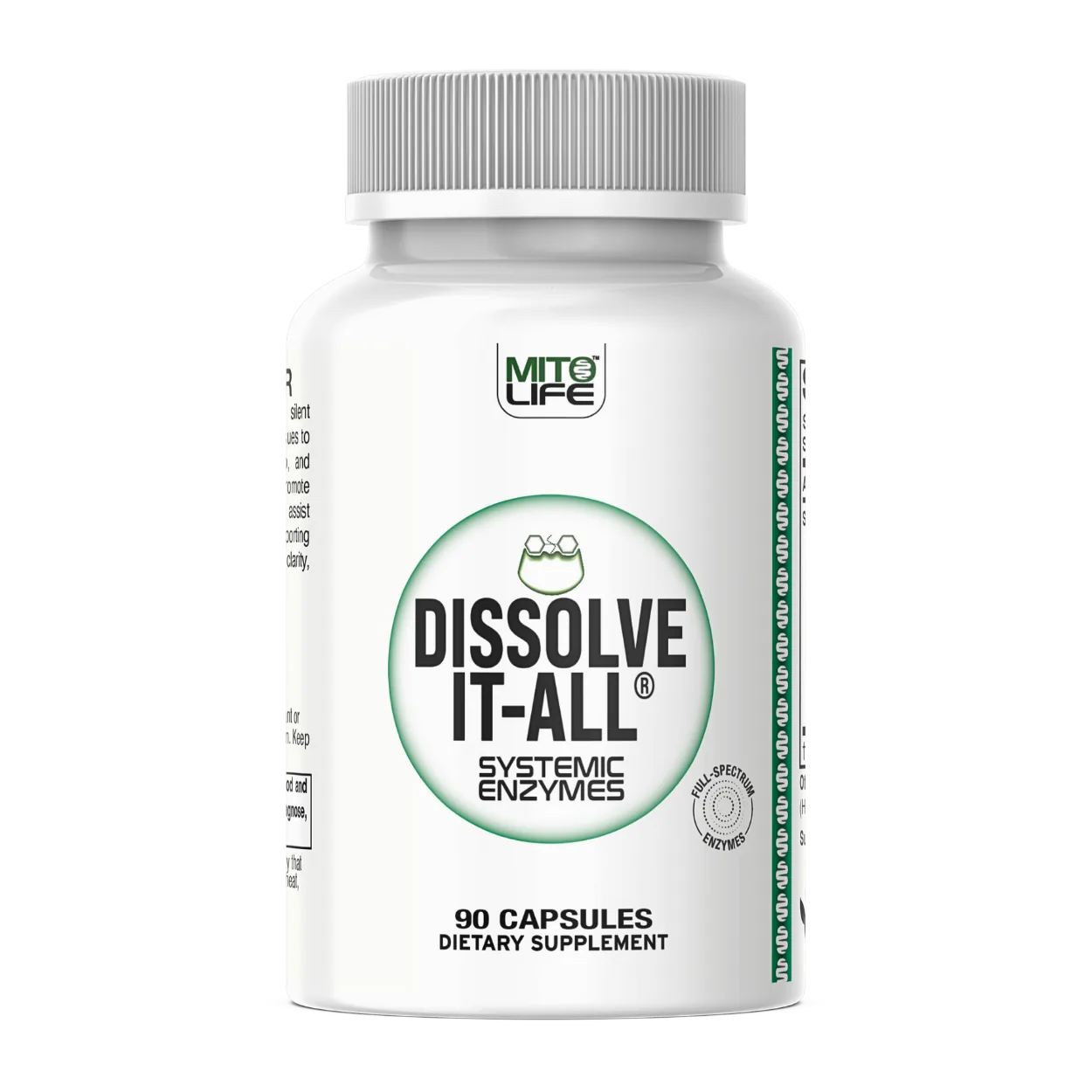
A blend of proteolytic (protein-digesting) enzymes taken between meals rather than with food, so they act systemically instead of on a meal. Used this way, proteolytic enzymes support the body's normal, everyday breakdown and clearing processes.
Why the evidence supports it
Proteolytic enzymes have a real but still-developing research base for supporting a normal inflammation response and the body's routine clearing work when taken away from food — an honest 'growing evidence' tier rather than a settled one. The rationale is mechanistic: unoccupied by a meal, these enzymes stay available to the body's own housekeeping. So the claim stays modest — this serves the cell's Maintain function, the ordinary daily upkeep, not a cleanse that fixes anything. Taken away from meals with plenty of water is how it is meant to be used.
What it supports
- Supports the body's normal breakdown and clearing processes
- Provides proteolytic enzymes taken between meals
- Supports a healthy inflammation response already within normal range
- Complements good hydration and a balanced routine
Which function it supports
Ties to the cell's Maintain function — supporting the body's normal daily upkeep. What people use it for is a matter of preference, not a proven medical outcome.
Learn the why behind this pillarHow it relates to your cells and mind
Every product here ties back to a specific job your body does. This one touches the functions below — follow either link to see the mechanism in full, then dig into the studies.
What it is made of — and the mechanisms behind it
Each ingredient acts on several of the body's functions. Taken together, this product touches these cell and mind functions — follow any to see the mechanism in full.
The ingredients
Mechanisms drawn from our ingredient knowledge base (1 profiled ingredients). Structure and function only — not a treatment claim.
The science on the ingredients
Serratiopeptidase: A systematic review of the existing evidenceSystematic review2013
Systematic review of serratiopeptidase trials found supportive but generally low-quality evidence for anti-inflammatory and edema-reducing effects; authors explicitly call for higher-quality studies. CONTESTED/low-certainty.
Bhagat S; Agarwal M; Roy V — International Journal of Surgery
The Effect of Nattokinase-Monascus Supplements on Dyslipidemia: A Four-Month Randomized, Double-Blind, Placebo-Controlled Clinical Trial.EmergingRandomized controlled trial2023
A four-month randomized trial found nattokinase-Monascus supplementation improved LDL cholesterol and related lipid ratios without adverse events in dyslipidemia patients.
Liu X; Zeng X; Mahe J; Guo K; He P; Yang Q; Zhang Z; Li Z — Nutrients
Nattokinase decreases plasma levels of fibrinogen, factor VII, and factor VIII in human subjects.EmergingClinical trial2009
A clinical study found nattokinase supplementation decreased plasma fibrinogen, factor VII, and factor VIII levels without significant adverse events in human subjects.
Hsia CH; Shen MC; Lin JS; Wen YK; Hwang KL; Cham TM; Yang NC — Nutrition research (New York, N.Y.)
Nattokinase: A multifunctional food-derived enzyme for thrombophilia management.EmergingExpert review2026
Nattokinase exerts antithrombotic effects through fibrin degradation, platelet aggregation inhibition, and antioxidant and anti-inflammatory actions relevant to thrombophilia management.
Ma Y; Jia H; Fan J; Kang X; Huang W; Li Y; Li J — Life sciences
Comparative Cardioprotective Effectiveness: NOACs vs. Nattokinase-Bridging Basic Research to Clinical Findings.EmergingExpert review2024
A narrative review compared cardioprotective mechanisms of direct oral anticoagulants and nattokinase, two approaches to vascular protection beyond standard anticoagulation.
Muric M; Nikolic M; Todorovic A; Jakovljevic V; Vucicevic K — Biomolecules
Microbial production of nattokinase: current progress, challenge and prospect.EmergingExpert review2017
Extraction and purification methods are critical for nattokinase quality evaluation, with microbial production progress and challenges reviewed for future development.
Cai D; Zhu C; Chen S — World journal of microbiology & biotechnology
Nattokinase: production and application.EmergingExpert review2014
This review summarizes biotechnological approaches for nattokinase enzyme production, recovery, and purification methods used in supplement manufacturing.
Dabbagh F; Negahdaripour M; Berenjian A; Behfar A; Mohammadi F; Zamani M; Irajie C; Ghasemi Y — Applied microbiology and biotechnology
Nattokinase-Associated Hemoperitoneum in an Elderly Woman.EmergingCase report2021
A case report described hemoperitoneum following nattokinase use, highlighting bleeding-related safety mechanisms to consider with this supplement.
Ramachandran L; Aqeel A; Jafri A; Sidhu Y; Mohamed Djirdeh T — Cureus
A single-dose of oral nattokinase potentiates thrombolysis and anti-coagulation profiles2015
In a single-dose human crossover study, oral nattokinase was associated with changes in fibrinolysis and anticoagulation markers (e.g., D-dimer, factor VIII), a circulatory structure/function signal. Systemic-enzyme area remains early and contested.
Kurosawa Y; Nirengi S; Homma T; et al. — Scientific Reports
Study on the transport and internalisation mechanism of dietary supplement nattokinase in the small intestine using animal and Caco-2 cell monolayer models.EmergingPreclinical study2023
Nattokinase transport and internalization in the small intestine was studied using animal and Caco-2 cell monolayer models to characterize absorption mechanisms.
Feng H; Liu C; Liu Q; Wang J; Zeng Y; Sun Y; Zhang M; Zhang H — Xenobiotica; the fate of foreign compounds in biological systems
Stepwise Strategy to Identify Thrombin as a Hydrolytic Substrate for Nattokinase.EmergingPreclinical study2022
Thrombin was identified as a novel biological substrate for nattokinase, expanding understanding of its antithrombus mechanism involving inflammation and oxidative stress pathways.
Wang Y; Wang H; Zhang Y; Xu F; Wang J; Zhang F — Journal of chemical information and modeling
Toxicological assessment of nattokinase derived from Bacillus subtilis var. natto.EmergingAnimal study2016
A subchronic toxicology study found nattokinase has a no-observed-adverse-effect level of 1000 mg per kg per day in rats, indicating low toxicological concern.
Lampe BJ; English JC — Food and chemical toxicology : an international journal published for the British Industrial Biological Research Association
Effects of Mulberry Leaf and Corn Silk Extracts Against Alpha-Amylase and Alpha-Glucosidase In Vitro and on Postprandial Glucose in Prediabetic Individuals: A Randomized Crossover TrialEstablishedRandomized controlled trial2025
Mulberry leaf extract inhibited alpha-amylase and alpha-glucosidase in vitro and lowered the post-meal glucose rise in a randomized crossover trial, linking the enzyme mechanism directly to the human postprandial result in the same paper.
Sun Y et al. — Nutrients
Anti-stress effect of theanine on students during pharmacy practiceEmergingRandomized controlled trial2013
Lower subjective stress and salivary alpha-amylase in higher-anxiety students -- Setting and subgroup limit generalization
Unno K et al. — Pharmacology Biochemistry and Behavior
Nutritional Wheat Amylase-Trypsin Inhibitors Promote Intestinal Inflammation Via Activation of Myeloid CellsClinical trial2017
Cited in Lustig's "Metabolical" (Chapter 14: What and how adults eat) to support the claim: "only two of them are the ones in gluten."
V.F. Zevallos et al — Gastroenterology 152 (5) (
Relora on stress in healthy premenopausal womenEmergingRandomized controlled trial2008
State anxiety improved -- Cortisol amylase sleep appetite and body measures did not improve (Magnolia plus Phellodendron evidence)
Kalman DS et al. — Nutrition Journal
Analysis of Protein Digestion and Absorption Using a Ussing Chamber to Simulate the Environment in the Digestive Tract.2024
A Ussing chamber model with Caco-2 cells and digestive enzymes pepsin and pancreatin was used to compare digestion and absorption rates of proteins from infant formula, milk, and soy milk.
Zhang X; Kaneko M; Liu W; Stephen OA; Nakamura K; Yamaguchi M; Yoshida C; Oishi T; Kobayashi S; Mizoi K; Ogihara T — Journal of nutritional science and vitaminology
Synthesis and release studies on amylose-based ester prodrugs of fenamic acid NSAIDs.2024
Researchers created colon-targeted amylose-based ester prodrugs of mefenamic acid, showing the conjugate remained stable in physiological media and activated only when amylose-degrading enzymes were present.
Chugh S; Sharma M; Chandrasen G; Mudila H; Prasher P — Therapeutic delivery
Based on green synthesis, multisensory evaluations and molecular simulation approaches: Exploring the taste-enhancing characteristics and mechanisms of N-succinyl-L-leucine.2024
Using digestive enzymes protamex and pancreatin, researchers enzymatically synthesized N-succinyl-L-leucine, a compound that enhanced umami, saltiness, and kokumi taste sensations in sensory testing.
Huang P; Wang Z; Ma Y; Zhao X; Cui C — Food research international (Ottawa, Ont.)
Isolation and antioxidant activity of peptides from Chinese hairy tofu.2024
Pancreatin-hydrolyzed hairy tofu peptides showed the highest antioxidant activity among seven proteases tested, with four purified peptides significantly reducing malondialdehyde content in H2O2-stressed 293T cells at concentrations below 50 micrograms per mL.
Wu LP; Wu YX; Ke XT; Wang P; Zhang S; Zhu YT; Lu Y; Shu YJ; Jiang SY; Li CJ; Hu XQ — Journal of peptide science : an official publication of the European Peptide Society
Evaluation of the Enzyme Inhibition, Antioxidant, and Antimicrobial Activities of Apricots, Plums, and Their Hybrid Fruits.2024
Comparing apricots, plums, and their hybrid found the hybrid fruit had higher antioxidant activity and inhibited acetylcholinesterase and alpha-glucosidase enzymes more than either parent fruit, while none of the fruits inhibited lipase or amylase.
Mihaylova D; Desseva I; Tumbarski Y; Popova A; Pandova S; Lante A — Plants (Basel, Switzerland)
Polymer Encapsulated Liposomes for Oral Co-Delivery of Curcumin and Hydroxytyrosol.2023
Curcumin and hydroxytyrosol were co-encapsulated in polymer-coated liposomes to improve their survival through the digestive tract, addressing their normally poor absorption and stability.
De Leo V; Maurelli AM; Giotta L; Daniello V; Di Gioia S; Conese M; Ingrosso C; Ciriaco F; Catucci L — International journal of molecular sciences
Antioxidant, anti-inflammatory, hypoglycemic, and anti-hyperglycemic activity of chickpea protein hydrolysates evaluated in BALB-c mice.2023
In BALB-c mice, chickpea albumin protein hydrolysates produced by alcalase or pepsin-pancreatin digestion showed antioxidant, anti-inflammatory, hypoglycemic, and anti-hyperglycemic activity in vivo, consistent with their in vitro antioxidant profile.
Navarro-Leyva A; López-Angulo G; Delgado-Vargas F; López-Valenzuela JÁ — Journal of food science
Ice Recrystallization Inhibition Activity of Soy Protein Hydrolysates.2023
Soy protein isolate hydrolysates inhibited ice recrystallization by up to 57 percent, with a 4-14 kDa peptide fraction showing the greatest activity linked to altered hydrogen bonding at the water-air interface.
Fomich M; Día VP; Premadasa UI; Doughty B; Krishnan HB; Wang T — Journal of agricultural and food chemistry
Balanced by design — we show supporting and contradicting findings. Search all studies
No product works in isolation
Every cell function above — Sense, Exchange, Transform, Build, Maintain, Adapt — needs the same broad base of optimal micronutrient levels running underneath it, all the time. Dissolve-It-All is not a stand-alone fix; it is one piece that plugs into that larger system. The foundation comes first, and this supports it.
Stacks well with
Pick your goal — here is what Dissolve-It-All pairs with for each. Nothing works in isolation; these share the same systems.
For Detox
For Gut Health
Foundational, or targeted?
Not everything in the shop is meant to be taken forever. Some products here are foundational — a daily nutrient base built for long-term, ongoing use. Others are targeted -- shorter-term support for a specific season, not a lifelong habit. If you are not sure which one this is, that is a fair question to ask us before you buy.
Learn more, on your terms
Do not take our word for it — go read. Each topic below opens a pre-loaded search so you can explore the nutrient, the mechanism, or the device for yourself.
Search the full studies libraryHow to use it
Take on an empty stomach, away from meals by an hour or two, with a full glass of water so the enzymes act systemically rather than on food. Follow the brand's serving size.
Use code HOLISTICLOVE at checkout.
Where to get it
We are lining up the best way to get this one to you. In the meantime, reach out and we will point you the right way — or browse the full shop to see every product.
See the full shopThe studies
See the research behind the science we point to.
Explore studiesThe blog
Plain-language reads on how it all fits together.
Read the blogOptimal nutrients are the definition of longevity
Long-term cell function depends on having what it needs, at the level it needs it, for as long as it needs it. That is the whole thesis behind everything we point you to here.
When you buy through our links, we earn a small commission — and that is what funds all the free education here. It never costs you more. Products are not intended to diagnose, treat, cure, or prevent any disease.
Dissolve-It-All is a blend of proteolytic (protein-digesting) enzymes taken between meals rather than with food. Many people use enzymes this way to support the body's normal, everyday breakdown and clearing processes. It fits people who like systemic enzyme support as part of a balanced routine.
Common questions
What does Dissolve-It-All support?+
It supports the body's normal breakdown and clearing processes, provides proteolytic enzymes taken between meals, supports a healthy inflammation response already within normal range, and complements good hydration and a balanced routine.
How do I take it?+
Take on an empty stomach, away from meals by an hour or two, with a full glass of water so the enzymes act systemically rather than on food. Follow the brand's serving size.
What makes it different?+
The language stays honest — it is an enzyme blend people take to support normal housekeeping, not a cleanse that fixes anything. What people use it for is a matter of preference.